
The Teacher Who Awakens the Mind and Builds the Character | The Teacher Who lighten the Light within
NV Paulose, Chairman, Global TV +91 98441 82044
“A true teacher teaches life more than the subjects they are assigned to teach.” Some teachers enter our lives to teach mathematics, science, engineering, literature, or history. A rare few enter our lives and, without announcing it, begin teaching us how to look at existence itself.
Their lessons are beyond classrooms or textbooks. They continue in our thoughts, our questions, our choices, and sometimes in the way we understand ourselves many years later. Prof. Dr. C. N. Paulose belongs, in the memories of those who have known and learned from him, to this rare tradition of teachers. His influence was connected with the formation of a mind and the cultivation of character.
His influence impacted many beyond formal education into questions of integrity, independent thinking, values, responsibility, and the possibilities within and outside. His professional journey as a professor at Mar Athanasius College of Engineering and as the founding principal of Viswajyothi College of Engineering and Technology is important,
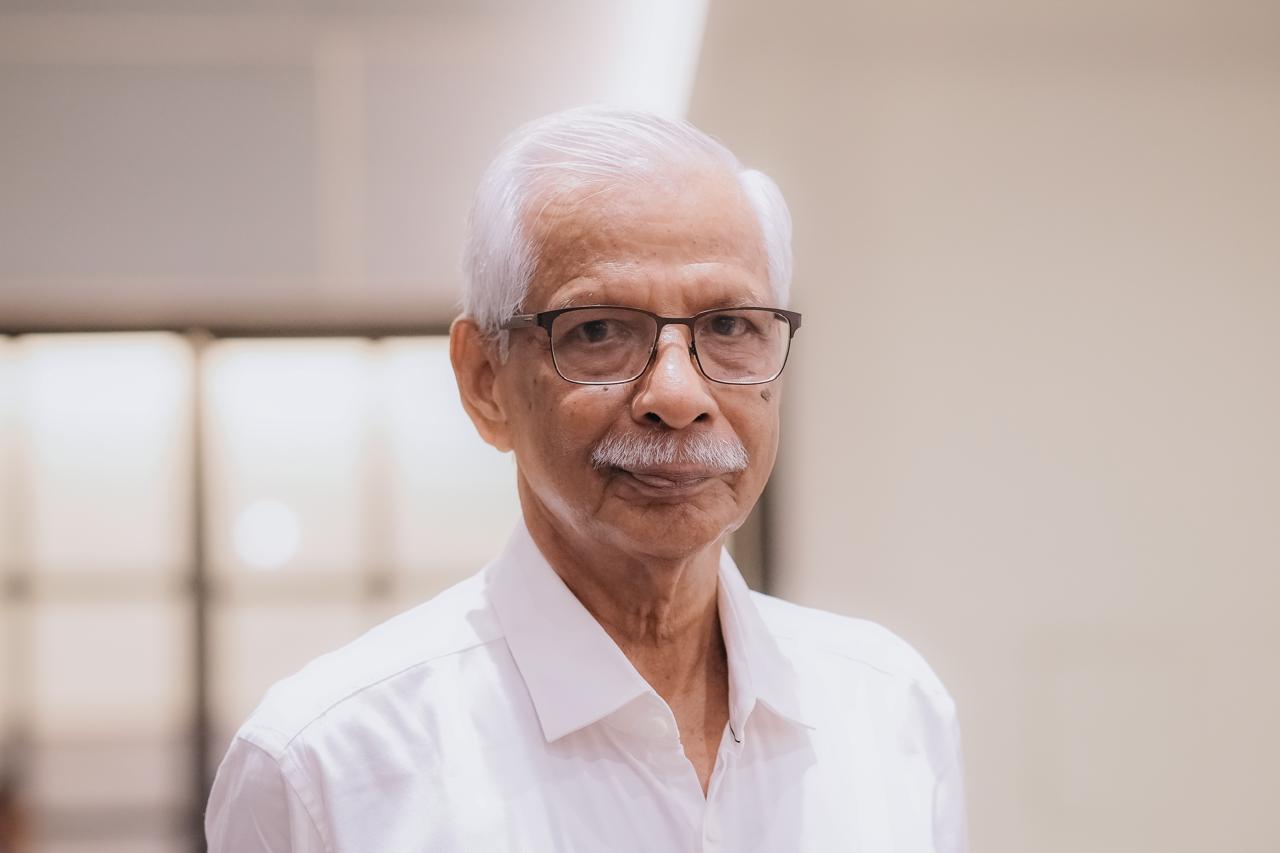
Thousand times more important is the human influence remembered by those who encountered him at the critical paths in their life journey. He resembles the teacher who goes in search of the lost sheep. Such a teacher does not measure a student by status or academic performance. He notices the person behind the performance. He understands that a student may be carrying doubts, disappointments, fears, or unrealized potential. He therefore teaches not only what is written in the curriculum but also what is necessary for a person to become fully alive. Sometimes the most important lesson is not an answer but a question. Sometimes the greatest gift of a teacher is not knowledge but the courage to think independently; even beyond convictions.
What makes Prof. Dr. CN Paulose more remarkable is his vast reading and unending curiosity. A person who reads widely does not remain imprisoned within the wisdom of one generation. Through books, ideas, history, philosophy, science, literature, poetry, and spiritual inquiry, such a mind converse with people who lived centuries ago and with people who have not yet been born. The search for truth becomes larger than one’s own lifetime. A teacher of this kind becomes a bridge between generations. He receives something from those who came before and passes it forward, transformed by his own understanding.
And perhaps this is what education is ultimately meant to accomplish. It should not merely produce people who know more. It should produce people who see more deeply. It should make us more capable of asking what knowledge is for, what character is for, and what we intend to do alone and otherwise with the brief opportunity called life.
When the River Meets the Ocean
One of the most memorable conversations I had with this remarkable teacher is the possibility of rebirth. I asked him about it. His answer was not a theological declaration or a philosophical performance. He simply said, “I do not know.” There was something deeply refreshing in those words. Here was a person who had read widely, reflected deeply, and thought across generations, yet he did not feel compelled to manufacture certainty where certainty was unavailable.
“I do not know” can sometimes be a more profound statement than an elaborate answer. It is an admission that mystery exists. It is an acknowledgment of the boundary between knowledge and speculation. In an age when people often speak with absolute confidence about things they have barely examined, the willingness to remain honest before mystery is itself a form of wisdom.
Our conversation went into Khalil Gibran’s beautiful image of the river approaching the ocean in his poem “Fear.” The river has travelled a long distance. It has passed through mountains and valleys, carried memories of its journey, and developed an identity of its own. Yet eventually it reaches the point where it must surrender its separateness to the vastness of the ocean. The river fears because it does not know what will happen to it when it ceases to be a river. But perhaps what appears to be an ending is actually a transformation.
Why should the river fear the ocean?
The river has no way of returning to where it began. Its journey is forward. Its destiny is not to remain permanently within its familiar boundaries but to enter something greater than itself. When it merges with the ocean, it does not become meaningless. It becomes part of a vastness that it could never have understood while remaining a separate stream. That image led me to another question. If human beings are to merge into the energy of God, how can we do so without first purifying ourselves? How can something imperfect enter the divine without being transformed? The answer I received was unexpected.
The river enters the ocean with all that it carries, both its good and its bad. And the ocean has its own mechanisms of transformation through its immense cycles. Whether one accepts that metaphor as theology, philosophy, poetry, or simply as an invitation to reflection, it contains a profound idea. We are all unfinished. Each of us carries goodness and weakness, wisdom and ignorance, generosity and selfishness.
We spend our lives trying to become better, but none of us reaches the end as a completely finished human being. Perhaps transformation is not something that happens only after we have become perfect. Perhaps transformation is the very process through which we become more than what we were. This thought connects beautifully with the verses about Bethlehem, Calvary, and Joseph’s tomb: “I know not how.” The speaker does not claim to understand the ultimate mechanics of incarnation, redemption, or resurrection. Instead, he arrives at something simpler and more intimate: “I only know.” I may not know how the mystery works, but I know what love has done to me. I may not understand immortality, but I know that the life of Christ has changed my understanding of life. I may not possess an explanation for everything, but I can recognize the transformation produced by love.
Perhaps that is the point at which philosophy and faith meet. We continue to ask, but we do not demand that every mystery become a formula. We search for truth while accepting that some truths may always remain larger than our capacity to explain them.
The Quiet Evolution of Goodness
From this extraordinary teacher and this intimate conversation, the thought naturally moves toward something much larger: the possibility that humanity itself is evolving toward greater goodness. This does not mean that the world has become free of violence, greed, injustice, hatred, or suffering. History gives us abundant evidence of human failure. But history also gives us another story, one that is often quieter and therefore easier to overlook. Goodness is constantly emerging in countless places, through countless people, often without recognition.
A teacher patiently explaining a difficult idea to a struggling student is an act of goodness. A person forgiving another after being hurt is an act of goodness. A scientist dedicating years to knowledge that may benefit people whom she will never meet is an act of goodness. A parent sacrificing for a child, a stranger helping another stranger, a young person standing beside someone who feels abandoned, an elderly person passing wisdom to the next generation, or an ordinary citizen choosing honesty when dishonesty would be easier are all small movements in the same direction.
Perhaps the evolution of humanity does not happen only through spectacular discoveries or historical revolutions. Perhaps it happens through the gradual transformation of human consciousness. One generation learns something that the previous generation did not know.
One person questions a prejudice that was inherited without check. Someone decides not to pass hatred to their children. Someone learns compassion where there was once indifference. Someone discovers that another human being, despite differences of language, religion, culture, nationality, or circumstance, possesses the same fundamental dignity.
Goodness therefore travels.
It travels from teacher to student, from parent to child, from one generation to another. A sentence spoken by a teacher may remain in the mind of a student for decades. That student may later say something similar to another person. That person may carry it into another family, another classroom, another profession, another generation. We rarely know where the influence ends. Perhaps it never truly ends.
This is why the life of a teacher can be far greater than the visible boundaries of his or her profession. A teacher does not merely teach the students sitting before him. Through them, he may influence people he will never meet. His ideas can travel through generations. His values can become part of decisions made long after he has left the classroom. His influence becomes a kind of invisible inheritance.
And perhaps that is one of the most hopeful ways of looking at the world. We often ask whether humanity is becoming better. Perhaps the more meaningful question is whether goodness continues to find new human beings through whom it can express itself. The answer seems to be yes. Every generation produces people who choose compassion over cruelty, truth over convenience, curiosity over prejudice, and service over selfishness. The world is still unfinished, just as each human being is unfinished. But unfinished does not mean hopeless.
A river is unfinished while it is travelling toward the ocean. A student is unfinished while learning. A civilization is unfinished while evolving. Perhaps life itself is a continuous movement from one form of understanding to another. The great teacher does not tell us that the journey has ended. He teaches us how to travel. He teaches us to ask. He teaches us to read. He teaches us to doubt our own certainty.
He teaches us to search for truth across generations. He teaches us to recognize values in action. And sometimes, when the question is greater than any answer he can honestly give, he teaches us the wisdom of saying, “I do not know.” Perhaps that is enough to keep the river moving. Perhaps the ocean is not merely where the river ends, but where it discovers that it was always part of something larger.
And perhaps humanity, with all its imperfections, is moving in much the same way: carrying both its light and its darkness, learning from its mistakes, receiving wisdom from the past, creating new possibilities for the future, and slowly discovering that goodness, like a river, has many tributaries and no single source. The world may not yet be the place we hope it will become. But goodness is everywhere. It is being taught. It is being learned. It is being lived. And it is being passed from one human being to another. That, perhaps, is how the world changes.


