
From Storytelling Homes to a Network of Connected Families
NV Paulose, Chairman, Global TV +91 98441 82044
Storytelling Homes begins with a simple belief: every family has a story, every home holds a wealth of experience, and every meaningful conversation has the power to bring people closer. A family is not merely a group of individuals living together. It is a repository of memories, traditions, values, skills, relationships, and aspirations. When families share their stories, they discover common ground, appreciate experiences, and develop relationships that may otherwise never have existed.
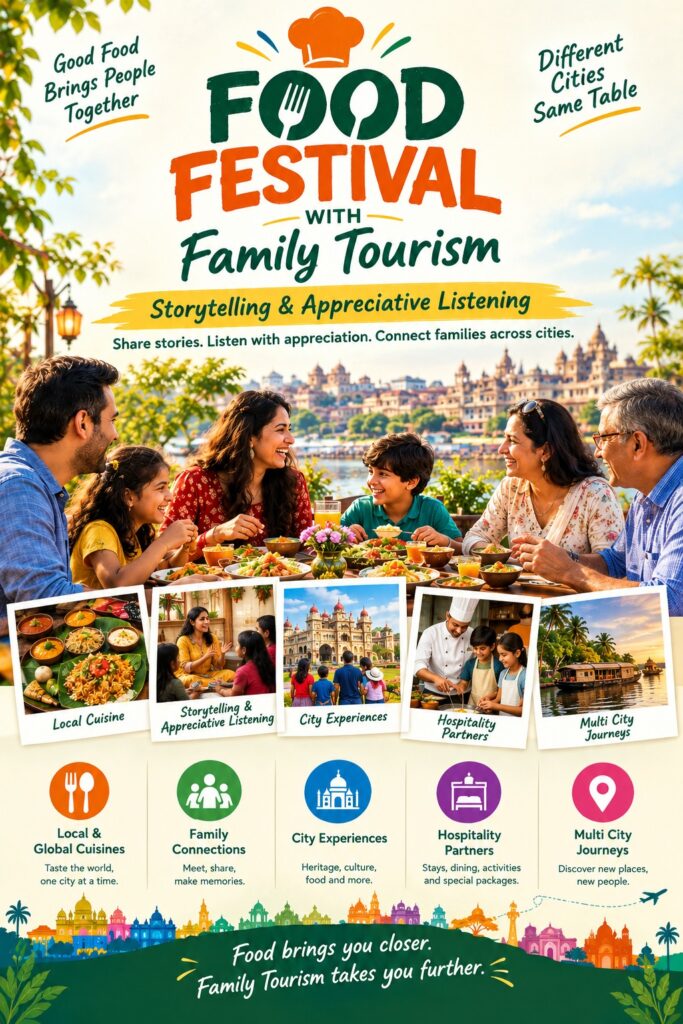
The next step is Integrated Family Tourism, an initiative that extends this philosophy beyond individual homes and neighbourhoods to connect families across cities. If Storytelling Homes encourages people to discover the value within their own families, Integrated Family Tourism invites them to discover the value in other families. It transforms tourism from a journey between destinations into a journey between people. The idea is to connect cities through families and bring families into the wider hospitality ecosystem. Tourism has traditionally focused on destinations, accommodation, transportation, sightseeing, and entertainment. Integrated Family Tourism introduces another dimension: relationships.
A family visiting another city should have opportunities not only to see its landmarks but also to experience its people, homes, food, traditions, and everyday life. This approach creates an opportunity for families to become active participants in tourism rather than remaining outside its commercial framework. It also offers the hospitality sector a way to expand its services, reach new customers, and develop revenue opportunities beyond conventional hotel stays.
Success Without Compromising Values
Success in life need not come at the cost of our values, relationships, or personal integrity. We do not have to compete at the expense of one another to grow economically or achieve our aspirations. There is another way forward: coming together, recognising each other’s strengths, and building opportunities through a Team Career. This represents a paradigm shift from individual achievement in isolation to collective progress through collaboration. Storytelling and Appreciative Listening help us discover the strengths, experiences, and aspirations of others, creating the foundation for trust and meaningful cooperation.
Collective collaboration and growing together can become faster and more sustainable economic mechanisms because they enable people to share knowledge, resources, networks, opportunities, and responsibilities. What one family cannot accomplish alone may become possible when several families, businesses, and communities work together. Integrated Family Tourism provides a practical platform for this approach, connecting families across cities while bringing them into the hospitality ecosystem. The objective is not merely to create more business, but to create shared prosperity. When our success creates opportunities for others, economic growth becomes a collective journey in which relationships are strengthened, values are preserved, and everyone has a greater chance to progress.
Bringing Families Under the Hospitality Umbrella
The hospitality industry has developed an extensive range of services to welcome and serve travellers. Hotels, resorts, restaurants, spas, convention centres, and recreational facilities have become important parts of the tourism economy. Yet much of the industry’s engagement with local families remains occasional and transactional. Families may visit a hotel for a celebration, a meal, a wedding, or a special event, but they are not always treated as a regular customer segment with distinctive needs and opportunities. Integrated Family Tourism proposes a broader understanding of hospitality. A hotel need not be a place used only by people who require a room for the night. It can become a welcoming destination for families seeking meaningful experiences, recreation, learning, relaxation, and social connection.
Consider a family living in one part of a city. They may rarely enter a nearby premium hotel because they associate it with overnight accommodation, business travellers, or expensive celebrations. However, the same family may be interested in a family lunch, a swimming session, a wellness experience, a cooking activity, a cultural programme, or a relaxed afternoon together. When hospitality models develop accessible and thoughtfully designed for such families, they can introduce an entirely new pattern of engagement. The hotel becomes a place to visit, not merely a place to stay.
The same principle can connect families across cities. A family travelling from Mysuru to Bengaluru, for example, could be introduced to a participating family in Bengaluru through a structured network. Their interaction might include a shared meal, a cultural experience, a storytelling session, or a guided visit to a local attraction. Hospitality partners could support the experience through dining, recreation, meeting spaces, and curated activities. The purpose is not to commercialise every family relationship. It is to create a trusted framework in which genuine relationships can develop while local hospitality businesses benefit from the additional activity.
City Day Outs: A New Opportunity for Hospitality
One of the most practical expressions of Integrated Family Tourism is the introduction of City Day Outs. A City Day Out allows a family to enjoy a planned experience within its own city or in a nearby destination without booking an overnight stay. A family might spend a morning enjoying breakfast at a hotel, participate in a cooking workshop, visit a garden or cultural attraction, have lunch with another family, and finish the day with a recreational activity. Another family might prefer a swimming session, a spa experience for eligible adults, a children’s activity, or an afternoon dedicated to food and conversation.
The programme could be designed around different interests, budgets, age groups, and occasions. Some families might choose a simple dining and recreation package. Others might prefer a cultural itinerary involving local artisans, heritage sites, storytelling, and traditional food. The defining feature would be the combination of hospitality services and opportunities for meaningful interaction.
For hotels, City Day Outs can help create demand during periods when rooms are not fully occupied. They can also introduce new customers who might otherwise never use the property’s facilities. A family that first visits for a day experience could later return for a celebration, a weekend stay, or another service.
City Day Outs can also encourage residents to rediscover their own cities. People frequently travel elsewhere in search of memorable experiences while overlooking the attractions, hospitality facilities, and cultural resources available close to home. A well designed local programme can turn familiar surroundings into opportunities for discovery.
The model must, however, respect the hotel’s existing guests and operational requirements. Day visitors need suitable facilities, clearly communicated prices, advance bookings where necessary, and an experience that justifies the cost. Hospitality operators should identify which services have available capacity and develop packages around those resources rather than compromising the experience of overnight guests.
Expanding the Hospitality Revenue Model
Hotel businesses generate revenue through several activities, including accommodation, restaurants, banquets, conferences, wellness facilities, recreation, and other services. The relative contribution of these activities varies considerably by property, location, customer segment, and operating model. Rooms may be the largest revenue source for some hotels, while food and beverage, events, or other departments can contribute substantially in others. Integrated Family Tourism should not depend on the assumption that every hotel earns more from non room activities than from accommodation. Its opportunity lies in helping hospitality businesses make better use of their facilities, expertise, and customer relationships.
A room is generally sold for a particular period to a particular guest. Dining, recreation, wellness, and event facilities can often serve multiple customers throughout the day. A hotel that has available capacity in these areas may be able to generate additional revenue by welcoming local families and visitors who do not require accommodation.
City Day Outs could be sold as individual services or as integrated packages. Revenue might come from restaurant bookings, activity fees, family memberships, cultural experiences, recreation packages, and partnerships with local attractions. Hotels could also collaborate with guides, transport providers, artisans, and family businesses, creating opportunities for several participants in the local economy.
For example, a hospitality property could offer a family day package that includes breakfast, a guided cultural activity, lunch, and access to selected recreational facilities. A separate package might bring two families together for a storytelling session and a shared meal. Another might connect visiting families with local families through a curated city experience.
The commercial principle is straightforward: develop additional reasons for customers to visit, make appropriate facilities available, and encourage repeat engagement. To succeed, the hospitality sector will need to treat family visitors as a meaningful customer segment. This means understanding their preferences, developing appropriate price points, maintaining service standards, and measuring the revenue generated by each programme. It also means designing experiences that are valuable in themselves, rather than simply discounting services that customers could already purchase separately.
Building a Network of Families Across Cities
Integrated Family Tourism becomes more powerful when individual experiences form part of a wider network. Imagine families in Mysuru, Bengaluru, Mangaluru, Kochi, and other cities participating in a common initiative. Each city would have its own participating families, hospitality partners, cultural experiences, and local activities. When a family travels, the network could help it discover suitable experiences and establish connections with families in the destination.
Storytelling Homes could provide the relational foundation for this network. Families could participate in structured conversations, share local knowledge, and identify common interests. Hospitality partners could provide suitable venues and experiences. Trained facilitators could help coordinate introductions and activities, while a central platform could manage bookings, partner information, feedback, and programme standards. Trust must remain at the centre of the initiative.
Participation should be voluntary, introductions should respect personal boundaries, and families should decide what information they wish to share. Home visits, where offered, would require appropriate consent and safeguards. Public venues and hotel facilities could provide convenient alternatives for families who prefer not to meet in private homes.
The initiative should also recognise that not every family has the same resources or preferences. Experiences need to accommodate different budgets, ages, accessibility requirements, and cultural backgrounds. The objective is to make meaningful participation possible without turning hospitality into an exclusive privilege. A practical beginning would involve a small group of families and a handful of hospitality partners in two connected cities. The programme could test City Day Outs, family introductions, shared meals, and storytelling experiences. Participation, customer satisfaction, repeat bookings, revenue, and the quality of relationships could then be evaluated before expansion.
The long term opportunity is to build a system in which families become a bridge between cities and hospitality becomes the platform that supports those connections. Integrated Family Tourism offers a new way to think about both tourism and community. It invites families to look beyond their immediate circles, cities to welcome one another through personal relationships, and hospitality businesses to recognise the value of serving people who may never need a hotel room.
Storytelling Homes creates the starting point. Integrated Family Tourism extends the relationship. City Day Outs provide an accessible way to participate. Together, they can help develop a more connected tourism economy in which commercial opportunity and human relationships reinforce each other. The destination of tourism need not be a place alone. It can also be a family, a friendship, a shared experience, or the beginning of a lasting connection between two cities.


