
We Are Already in the Train of Happiness | The courage not to defend oneself
NV Paulose, Chairman, Global TV +91 98441 82044
Rev. Dr. Valerian Prashanth Madtha, SJ, is not easy to describe in a single sentence. He has been a Jesuit, teacher, principal, scholar, writer, lexicographer, institution builder, and spiritual thinker. His life has moved through education, literature, language, culture and spirituality, yet beneath these different expressions there seems to be a single habit of mind: the desire to look more deeply at life and to discover the wisdom already present within it.
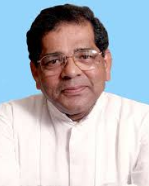
His contribution to language is substantial. His Padanidhi is recognised as a pioneering Kannada thesaurus, while his work in Konkani includes Konkani Thesar and a collection of thousands of Konkani idioms. He has written in Kannada, Konkani and English and has served in several Jesuit educational institutions. He was also honoured with the Karnataka Rajyotsava Award in 2024 for his contribution to literature. Yet a list of accomplishments does not quite explain Fr. Madtha. To understand him, one has to listen to the philosophy beneath the accomplishments.
The wisdom of a forest
That philosophy begins with something remarkably simple. Look at a forest. Every leaf has its own space. Every cell has its own space. Living things communicate with one another. When a tree is attacked, it can send signals through its roots and trigger responses in other trees. A forest is not merely a collection of individual trees. It is a community in which life is constantly responding to life.
For Fr. Madtha, this is more than an observation about nature. It becomes a spiritual insight. The universe, he suggests, operates through a kind of benevolence in which everything is connected, and everyone is, in some way, helping everyone else. The forest becomes a teacher. The ocean becomes a teacher. The human body becomes a teacher. Nature itself becomes a language through which the universe speaks to us. This may explain something about the extraordinary breadth of his intellectual life. A man who has spent years searching for the right word in Kannada and Konkani is also searching for the right meaning in life. He is constantly asking what things are trying to tell us. He speaks of the ocean with particular affection. The ocean becomes another image of abundance, biodiversity, movement and care.
A life prepared for the moment
There is another important idea in his conversation. When he sees someone accomplish a great deal in a short period, he says that the achievement is rarely sudden. The preparation has usually been taking place for years. Preparation happens quietly, almost invisibly, until one day the moment arrives, and the accumulated preparation becomes visible. His own life seems to carry something of that pattern. The young Jesuit became a teacher. The teacher became an educational leader. The educator became a scholar of language. The writer became a lexicographer. The priest became a public intellectual whose reflections move freely between Christianity, Buddhism, Hindu thought, nature, psychology, and ordinary human experience. The achievement may be visible, but the preparation is usually hidden. That is one of the lessons contained in his life. What appears to be sudden accomplishment is often the result of years of invisible discipline, curiosity and attention.
The dark night that changes us
But Fr. Madtha does not describe transformation as something that happens when life is comfortable. Quite the opposite. He says that some of the most important turning points in his life came through deep crises, moments when existence itself was questioned and when he experienced something resembling what spiritual tradition calls the dark night of the soul. In such moments, he says, the darkness can suddenly give way to light, and when that happens, the entire paradigm changes.
He uses a striking metaphor for this process. The universe, he says, can be like someone running along a path. Suddenly something stretches across the path and makes the runner fall. Then the same force lifts the person up, and the person’s speed becomes greater than before. It is an unusual way of looking at suffering. Pain remains pain. Crisis remains crisis. He does not make suffering sound pleasant. But he suggests that we can look at difficult experiences differently. Instead of seeing every crisis simply as something from which we must escape, we can ask what the experience is demanding from us and what it might be preparing us to become. He calls it an encounter. The challenge is not merely something standing in our way. Sometimes it is the very encounter through which transformation becomes possible.
The train that never stops for us
This way of thinking appears again in one of the most memorable images in his conversation : the image of a train. Imagine that life is a train travelling towards a destination. We sit inside it with our luggage. We worry about our headaches, our financial problems, our possessions and everything that might go wrong. We look outside and become absorbed in the passing landscape.
But the train is not anxious. It knows where it is going. It continues towards its destination whether or not we understand where that destination lies. For Fr. Madtha, the train becomes an image of existence itself. We may not know the destination, but perhaps we do not have to control every part of the journey. There is something deeply liberating in that thought.
The train of happiness
Modern life constantly tells us that happiness is somewhere ahead of us. It is waiting in the next achievement, the next possession, the next promotion, the next recognition or the next spiritual experience. We keep moving towards something we believe will finally make us complete. Fr. Madtha turns that assumption upside down. What if happiness is not something we have to catch? What if we are already travelling towards it? He illustrates this through a story about a man who discovers a book called How to Catch the Train of Happiness. The man goes to a railway station and waits for the midnight train described in the book. Night after night, the train comes but does not stop.
Eventually, while waiting, he begins teaching poor children. He teaches them dance. He teaches them the alphabet. He begins organising women and young people and becomes involved in social work. Years pass. One day, exhausted after spending his time serving others, he is sitting on the railway platform when the train finally arrives and stops. In that moment, something happens inside him. He realises that the happiness he had been waiting to catch had already been present in the life he was living. He had been looking for happiness outside himself while already participating in it. Fr. Madtha calls this realisation enlightenment.
Happiness as recognition
This distinction between attaining and realising is at the heart of his spiritual thinking. We often imagine happiness as something that must be acquired. We imagine peace as a reward that comes after we have solved all our problems. We imagine spiritual life as a long journey towards a state we do not yet possess.
Fr. Madtha offers another possibility. There may already be a deposit of peace and happiness within us. The task is not always to acquire something new but to recognise what is already there. This is where his interest in different spiritual traditions becomes significant. He speaks about Christianity, Buddhism and Hindu thought not merely as systems of doctrine but as different ways of asking what it means to be free.
His spiritual imagination is therefore spacious. He can move from Jesus and the Cross to Buddha and the story of the lost cow, from the forest to the ocean, from the human body to the nature of consciousness. His interest is not simply in collecting religious ideas. It is in discovering what these traditions might teach a human being about freedom, happiness, and the nature of the self.
The courage not to defend oneself
Then comes perhaps the most demanding idea in the entire conversation. Fr. Madtha says that one of the greatest signs of spiritual maturity is that a person no longer needs to defend himself. He tells the story of a sage who is falsely accused of fathering a young woman’s child. The villagers condemn him. They beat him and give him the child. Yet the sage does not defend himself. He simply accepts the situation and cares for the baby. “Is it so?”
Eventually the truth comes out. The villagers return and apologise. The sage’s response is simply, “Is it so?” The story is powerful because most of us live at the opposite end of the spectrum. Accuse us, and we prepare our defence. Misunderstand us, and we rush to correct the record. Criticise us, and we gather evidence to prove that we are right. Our identity becomes something we feel compelled to protect.
Fr. Madtha’s question is much more unsettling. What if I do not have to defend myself at every moment? That does not mean abandoning truth or accepting injustice. It means refusing to make the ego the centre of every encounter. It means discovering an inner freedom that does not depend entirely on what other people think of us.
The wisdom of the Cross
For a Jesuit priest, this idea ultimately finds its deepest expression in Jesus. Fr. Madtha points towards the Cross as an extraordinary image of a person who refuses revenge. Even in suffering, Jesus does not respond with hatred. Instead, he speaks from within the experience of those who are crucifying him. Here his understanding of spirituality becomes demanding. The highest spiritual achievement is not simply to know more. It is to become less defensive, less possessive, less frightened and less dependent on recognition. It is to become capable of standing in the middle of misunderstanding without losing one’s inner freedom. That is a very different definition of strength.
A wordsmith who understood that words are worlds
There is a beautiful connection between this aspect of his life and his work as a scholar of language. Fr. Madtha has spent years collecting words, preserving words and exploring relationships between words. His linguistic scholarship is not merely technical. His work with Kannada and Konkani has helped map the richness of languages and preserve expressions that carry the memory of communities and generations.
But perhaps his deeper vocation has always been the search for meaning. What does suffering mean? What does happiness mean? What does freedom mean? What does a forest teach us? What does the Cross mean? What does it mean to be spiritual? And finally, what does it mean to be alive?
That may be why his reflections feel less like a formal lecture and more like a conversation with someone who has spent a lifetime observing. He observes nature. He observes people. He observes himself. He observes religion. He observes suffering. And he keeps asking questions. Perhaps that is the thread connecting the teacher, the writer, the Jesuit and the spiritual seeker.
He is still listening.
You are already in the train And perhaps the most memorable lesson from his entire philosophy is contained in the story of the train. We spend so much of our lives waiting. Waiting to become successful. Waiting to become peaceful. Waiting to become loved. Waiting to become significant. Waiting for the right circumstances. Waiting for the train. Meanwhile, life is already moving. The forest is breathing. The ocean is moving. People are helping one another. A child is waiting to be taught. A word is waiting to be discovered. A crisis is waiting to transform us. A moment of silence is waiting to reveal something.
And perhaps happiness is not standing at some distant platform. Perhaps we are already inside the train. The journey is happening. The destination is not entirely ours to control. The task is to wake up, to look around, to realise, to participate, to stop defending the small self at every turn and to discover that the peace we have been pursuing may already have been quietly travelling with us. That is the deeper significance of Rev. Dr. Valerian Prashanth Madtha, SJ. His life is not simply a record of positions held, books written or institutions served. It is a long conversation with the mystery of existence.
A Jesuit became a teacher. The teacher became a scholar. The scholar became a wordsmith. The wordsmith became a storyteller. And the storyteller keeps returning to one of the oldest and most difficult truths of spiritual life. Perhaps the greatest journey is not the journey towards becoming someone else. It is the journey towards realising who we already are.


