
Why India’s Education System Must Make Skills the Main Course, Not a Side Dish
By Ashwini, Founding Member, Mangalore Listeners Club
- An initiative of Mangalore Listeners Club: Conversations That Matter.
India takes considerable pride in its demographic advantage. With a large and predominantly young population, the country has an enormous reservoir of human potential. We often describe this as our demographic dividend, an opportunity that could play a decisive role in shaping India’s economic and social future. But an important question needs to be asked: Are we doing enough to prepare this young population to realise its potential? And, more importantly, are our educational institutions equipping young people with the competencies required to succeed in a rapidly changing world?
These questions formed the starting point of my conversation with Dr. P. S. Yadapadithaya, Former Vice Chancellor of Mangalore University, when we turned our discussion towards skill development and the larger question of employability. What began as a discussion about Skill India soon developed into a much wider examination of the disconnect between education and employment, the limitations of conventional classroom teaching, the responsibilities of universities and the urgent need to rethink how we prepare our youth.
One observation by Dr. Yadapadithaya stayed with me throughout the conversation. He cautioned that if India failed to handle the talents, potential and opportunities of its youth in a systematic and scientific manner, the much-celebrated demographic dividend could turn into a demographic disaster. It was a powerful reminder that a young population, by itself, does not guarantee progress. The real dividend emerges only when that population is educated, skilled, capable and productively engaged.
The missing link: Education, Employability and Employment
As we explored the subject further, Dr. Yadapadithaya introduced what he described as the three Es: Education, Employability and Employment. In his view, the Indian education system has traditionally concentrated on education and employment, often overlooking the critical link that connects the two. Educational institutions celebrate academic achievements, distinctions, ranks and degrees, while parents naturally look forward to seeing their children secure jobs after graduation. Institutions, too, often regard placement records as an important indicator of their reputation. Yet, between obtaining a qualification and being ready to perform in a professional environment lies the question of employability.
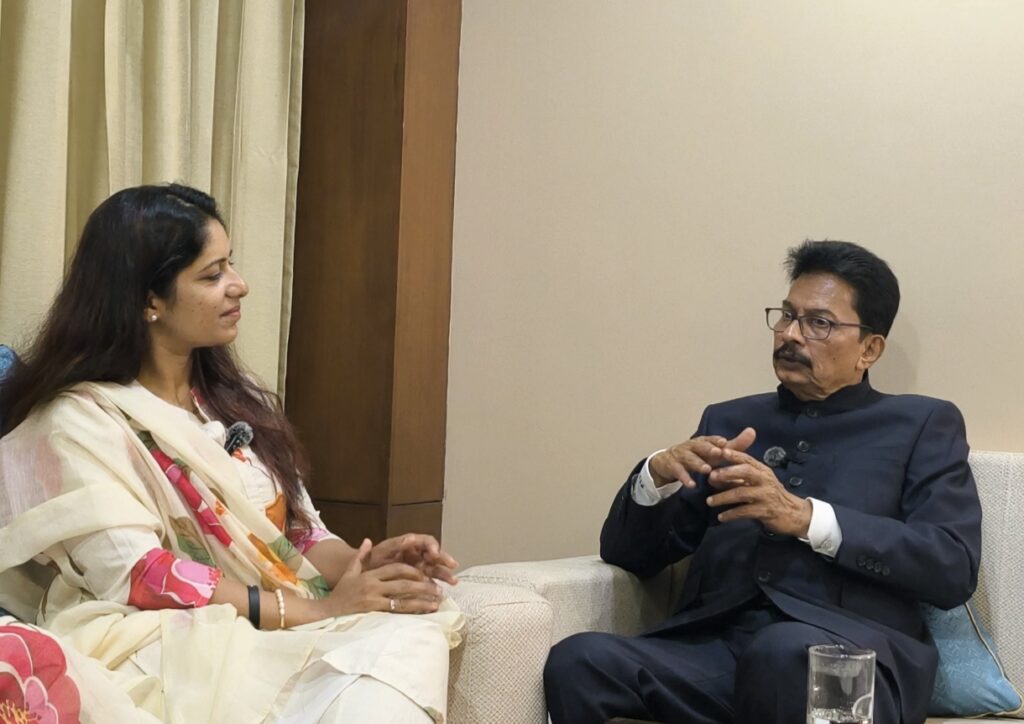
He made an important distinction between qualification and competency. Employers may acknowledge academic credentials, but what they ultimately seek is the ability to perform, solve problems and deliver results. A degree demonstrates that a person has completed a particular course of study; it does not necessarily establish that the person can apply the knowledge acquired to practical situations. This, according to him, is one of the fundamental weaknesses of Indian higher education: what is taught within educational institutions is not always practised in industry, while the realities and requirements of the workplace are not adequately reflected in classroom teaching.
The result is a considerable disconnect between theory and practice. Students may acquire theoretical knowledge and perform well in examinations, but when confronted with real-life problems, many struggle to translate that knowledge into action. The challenge, therefore, is not simply to produce more graduates. It is to produce graduates who can demonstrate competence in the environments in which they are expected to work.
CASH-V: Understanding what makes a person competent
One of the most interesting parts of our discussion was Dr. Yadapadithaya’s explanation of competency through a framework he calls CASH-V. He identifies five essential ingredients: Knowledge, Attitude, Skill sets, Habits and Values. What makes this framework particularly useful is that it moves the discussion beyond the conventional understanding of education as the accumulation of information and academic qualifications. Knowledge, as he explained, should not be limited to theoretical material acquired within the four walls of a classroom. Students need domain-specific and application-oriented knowledge that enables them to address real-life problems. He brought in the familiar framework of the five Ws and one H — What, Where, When, Who, Why and How — to emphasise the importance of questioning, understanding context and applying knowledge meaningfully. It is not enough to know something; learners must understand how, where and why that knowledge can be used.
The second ingredient, Attitude, is equally significant. Drawing attention to the influence of one’s mental outlook, he emphasised the importance of developing a positive, enthusiastic and constructive attitude towards learning and life. The way individuals approach challenges, respond to setbacks and engage with others often determines how effectively they use their knowledge and abilities. The third component is Skill sets. Here, he made it clear that the requirement extends far beyond technical skills. Students need a relevant and appropriate combination of technical, conceptual, administrative, interpersonal, communication and human-relations skills. Since the shelf life of many skills is becoming shorter, continuous upskilling and reskilling are essential. Learning cannot end with a degree or a professional certification; it must become a lifelong process.
Habits form the fourth ingredient. The discipline of learning, the ability to remain consistent and the willingness to improve should be cultivated during one’s educational years and carried into professional life. Finally, Values provide the ethical foundation for competence. Dr. Yadapadithaya particularly emphasised integrity, moral responsibility and ethical conduct. A person may be knowledgeable and technically capable, but without values, that competence remains incomplete. The CASH-V framework brings together the intellectual, behavioural, practical and ethical dimensions of human capability. It also offers educational institutions a useful way of looking at what they should actually be developing in their students.
Skills must become the main course, not the side dish
At one point in our conversation, Dr. Yadapadithaya used an analogy that captured the problem rather beautifully. He observed that our education system has treated skills as a side dish, whereas they should be part of the main course. Academic qualifications, syllabi, classroom teaching, examinations and degree certificates have traditionally occupied centre stage. Skill development, on the other hand, is often relegated to separate courses, occasional workshops or additional certifications.
He argued that this compartmentalised approach needs to change. Skill development cannot remain an activity that students undertake separately from their regular education. It must be integrated into the curriculum and syllabus so that the development of competencies becomes part of the learning process itself. A management student, for example, should not merely understand management concepts but also learn to communicate, analyse situations, work with people and make decisions. Similarly, students in technical disciplines must be able to connect their subject knowledge with practical application.
This distinction is important because adding a few industry certifications or short-term skill programmes does not necessarily address the deeper problem. What students need are strong foundational competencies that enable them to learn new technologies, adapt to changing professional requirements and perform effectively across different situations. The objective should be to integrate skills with education, rather than create separate compartments for academic learning and employability.
Bringing academia and industry together
The discussion then moved to one of the most persistent challenges in higher education: the relationship between educational institutions and industry. Dr. Yadapadithaya felt that interaction between the two has often been limited to occasional guest lectures, project guidance, internship opportunities, and campus recruitment drives. While these activities have their value, they do not amount to the kind of sustained partnership that is necessary to bridge the gap between education and employment.
He believes industry should become a genuine partner in the progress of educational institutions. Such a partnership must be built on mutual trust, confidence and goodwill, with both sides contributing to the process of designing, developing and periodically reviewing academic curricula. One practical area where this collaboration can begin is the composition of university Boards of Studies. Traditionally, these boards have been dominated by academicians. While their academic expertise is indispensable, the absence of adequate industry representation can result in a curriculum that does not fully reflect workplace realities.
Dr. Yadapadithaya recalled how, during his tenure as Vice Chancellor of Mangalore University, he sought to bring industry experts into Boards of Studies alongside academic representatives. His intention was to encourage a broader, 360-degree assessment of syllabi, ensuring that practical perspectives were considered in curriculum development and revision. He acknowledged that this was not always an easy process, as differences in outlook and expectations sometimes emerged between academics and industry professionals. Nevertheless, he considered such engagement necessary if universities were to remain relevant and responsive to changing requirements. The larger point is that curricula cannot remain static. They must be periodically examined, questioned, and updated. A syllabus that does not evolve with the world around it risks preparing students for circumstances that may no longer exist when they graduate.
Teachers, too, must experience industry
An especially thought-provoking suggestion during our conversation concerned the need to expose teachers to the world of industry. Dr. Yadapadithaya questioned how effectively teachers could prepare students for professional environments if they themselves had limited practical exposure to those environments. Academic qualifications, research credentials and teaching experience are undoubtedly important, but they do not automatically provide an understanding of the day-to-day realities of industry.
He therefore advocated industry sabbaticals for teachers, suggesting that such exposure should become an important element of their professional development and career progression. Teachers should have opportunities to spend time in organisations, understand their systems and challenges, and experience how theoretical concepts are applied in practice. This would enable them to bring real-world insights into the classroom and help students understand the connection between what they study and what they will eventually encounter in their careers.
He cited the example of Professor T. V. Rao, who, as recalled during the discussion, spent three years at HMT in Bengaluru on an industry sabbatical before returning to academia. Such experiences, Dr. Yadapadithaya suggested, can broaden a teacher’s perspective by providing an understanding of both sides of the knowledge-practice relationship. It is a valuable proposition: teachers must not only impart knowledge but also remain connected to the realities in which that knowledge is used.
From passive listening to active learning
Our conversation also brought us to the way teaching and learning happen inside classrooms. Dr. Yadapadithaya expressed concern about the continued dependence on passive learning, particularly the traditional lecture-based approach in which students are expected to listen, absorb information, and reproduce it during examinations. Referring to commonly cited learning-retention estimates, he drew attention to the greater learning opportunities created through discussion, practice, experiential learning, and teaching others. The precise percentages mentioned in the discussion would need independent verification, but the underlying message is clear: participation makes learning more meaningful.
He referred to David Kolb’s experiential learning model, which describes learning as a cycle of concrete experience, reflective observation, abstract conceptualisation and active experimentation. In simple terms, students should have opportunities to experience something, reflect on what happened, understand the underlying concepts and then apply their learning in new situations. Learning by doing, therefore, should not be treated as an occasional classroom activity but as an essential part of education.
He also recalled introducing an interesting practice at Mangalore University. At the end of each class, students were encouraged to take the final ten minutes to teach their fellow students. The exercise was intended to develop confidence, articulation and the ability to organise and communicate ideas. Importantly, students were not required to speak only in English. If they were more comfortable expressing themselves in Tulu, Kannada or another language, they were encouraged to do so. The objective was to help them articulate their thoughts rather than allow a lack of confidence in English to prevent them from participating.
I found this particularly relevant because communication is not merely about fluency in a particular language. It is also about clarity of thought, confidence, and the ability to convey an idea to another person. When students explain concepts to their peers, they are compelled to understand the subject more deeply. They also learn to listen, respond, and engage in discussion. Such experiences can build capabilities that conventional examinations may not adequately measure.
Developing different styles of thinking
Towards the latter part of our discussion, Dr. Yadapadithaya raised another important question: Are our classrooms encouraging students to think independently, or are they primarily training them to remember and reproduce information? He spoke about the importance of developing different styles of thinking and began explaining critical, analytical, creative, and abstract thinking.
Critical thinking, he explained, requires us not to accept things at face value. Students should learn to question assumptions, examine evidence, and repeatedly ask why. Analytical thinking involves breaking a larger idea into smaller components and examining them carefully. His illustration of peeling an onion layer by layer made the concept easy to understand: deeper examination requires looking beyond the surface and paying attention to the different elements that make up a subject.
Creative thinking, meanwhile, encourages imagination, innovation, and the ability to see possibilities beyond conventional answers. He illustrated this through the idea that one plus one need not always equal two; through synergy, the combined outcome can be greater than the sum of individual contributions. Abstract thinking, another approach he introduced, calls for the ability to understand ideas beyond their immediate or literal appearance. Referring to Peter Drucker, he also highlighted the importance of decision-making when complete information is not available, an ability that is particularly relevant in leadership and management. Although the recording available to me concludes while he is discussing these thinking styles, the ideas he introduced point towards an essential responsibility of education: developing minds that can question, analyse, imagine and make decisions, rather than merely memorise information.
Education must rise above political considerations
We also touched upon the broader policy environment, particularly the National Education Policy 2020. Dr. Yadapadithaya acknowledged the ambitious proposals and aspirations contained in the policy, but expressed concern that education policies can become entangled in political differences. His argument was that educational reforms must be assessed on their merits and their implications for students, rather than being accepted or rejected simply because of the political identity of the government that introduced them.
He also revisited the longstanding principles that have guided higher education in India: access, equity, quality, transparency, autonomy, accountability and affordability. Each of these has an important place in building an inclusive and effective education system. Education must be accessible to all sections of society, opportunities must be equitable, standards must be maintained, institutional processes must be transparent, and institutions must be accountable for their outcomes.
At the same time, higher education must remain affordable so that financial circumstances do not become an insurmountable barrier to learning. Yet, as he pointed out, India has had numerous committees, commissions and policy reports examining the challenges facing higher education. Problems have been identified, recommendations have been made, and solutions have been proposed. What is often missing is the willingness to implement them effectively. In his view, what is required is not merely political will but national will; a collective commitment to translate policy intentions into meaningful changes at the ground level.
The real measure of education
As I reflected on our conversation, one message became increasingly clear: the challenge before Indian education is not simply to expand access to degrees, but to ensure that those degrees translate into capability. Academic knowledge remains essential, but it must be accompanied by the ability to apply that knowledge, communicate effectively, work with others, adapt to change and act with integrity. These competencies cannot be developed through examinations alone. They require a learning environment in which teachers remain connected to industry, curricula evolve with changing needs, students participate actively, and educational institutions take responsibility for the outcomes they produce.
The responsibility is shared. Students must develop a habit of continuous learning; teachers must remain open to new experiences; universities must build meaningful partnerships with industry; employers must participate in shaping relevant learning opportunities; and policymakers must focus on effective implementation. No single stakeholder can bridge the education-employability gap independently.
My conversation with Dr. P. S. Yadapadithaya left me with a thought that deserves to be carried into every university, college, and classroom: skills must be the main course, not the side dish. It is time to move beyond an education system that measures achievement predominantly through qualifications and place greater emphasis on the competencies that enable individuals to contribute meaningfully to society. After all, the purpose of education cannot be limited to producing graduates. It must be to develop capable human beings who can think independently, act responsibly, adapt continuously, and make a difference.


